
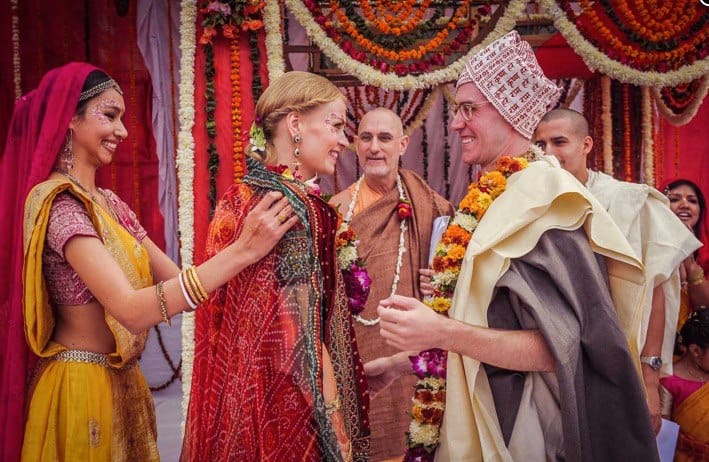
Is Marriage Connected to Past Lives?
– Is “Janam Janam Ka Saath” Real? A Gita-Based Perspective
In Indian culture, the phrase “जन्म जन्म का साथ” (lifetimes of togetherness) is often used in the context of marriage.
It raises a heartfelt question:
“Is marriage predestined? Are spouses connected through past lives?”
“Does our partner come into our life due to past karma?”
Let’s explore this from the spiritual lens of the Bhagavad Gita and Vedic wisdom.
1. The Soul Has Many Lifetimes
The Bhagavad Gita 2.13 explains that:
“Just as the boyhood, youth and old age come to the body, similarly, the soul passes into another body at death.”
This means we are eternal souls, constantly moving through cycles of birth and death.
In each life, we form attachments and relationships that may not end with death.
Some of those relationships—especially strong ones, like with a spouse—can carry over.
2. Marriage Is Often Karmic
According to Vedic astrology and karma theory, marriage doesn’t happen randomly.
It is usually the result of past karmic links between two souls.
You may have shared:
- a family bond in a past life,
- a debt, duty, or emotion left unfulfilled,
- or even devotional service together.
Such connections bring two souls together in this life—either to repay a debt, complete an unfinished emotional journey, or progress spiritually.
 This is why some marriages feel deeply connected from day one, while others feel complicated—both are outcomes of karmic accounts.
3. Does “Janam Janam Ka Saath” Really Exist?
Vedic texts do mention that some souls unite again and again due to strong bonds of love, duty, or attachment.
But Bhagavad Gita teaches us that unless the relationship is spiritual in nature, it’s part of the material cycle of repeated birth and death.
“They meet again in new bodies, but only if they haven’t transcended the cycle of karma.”
So yes, “janam janam ka saath” can happen,
but it’s usually a sign of unfinished material karma rather than divine love—unless that bond is rooted in Krishna consciousness.
4. Spiritual Marriage Transcends Lifetimes
If a couple comes together not just for bodily needs, but to serve God, grow spiritually, and help each other in bhakti—
then their relationship becomes a spiritual partnership.
Such relationships can break the cycle of karma and help both souls move closer to Krishna.
As Srila Prabhupada says:
“Husband and wife should see themselves as co-servants of Krishna.”
 A relationship based on Krishna bhakti isn’t bound by karma,
but is sanctified by grace.
5. What Should Be Our Approach?
Whether your marriage feels karmic, blissful, or challenging—
see it as an opportunity for purification and growth.
 Use it as a means to practice patience, forgiveness, service, and bhakti.
Help each other grow closer to Krishna.
Offer your relationship at His lotus feet.
This way, you elevate your bond from karmic to spiritual—from janma-janma to nitya (eternal).
 Conclusion
Yes, marriage can be a continuation of past lives.
But more importantly, it is an opportunity in this life—to help each other walk the path of devotion.
Instead of asking, “Have we been together before?”,
ask:
“Can we walk together toward Krishna now?”
That is the real success of a relationship—to transform karma into seva, and love into liberation.
Hare Krishna.